How to Organize a Bathroom Linen Closet Step by Step
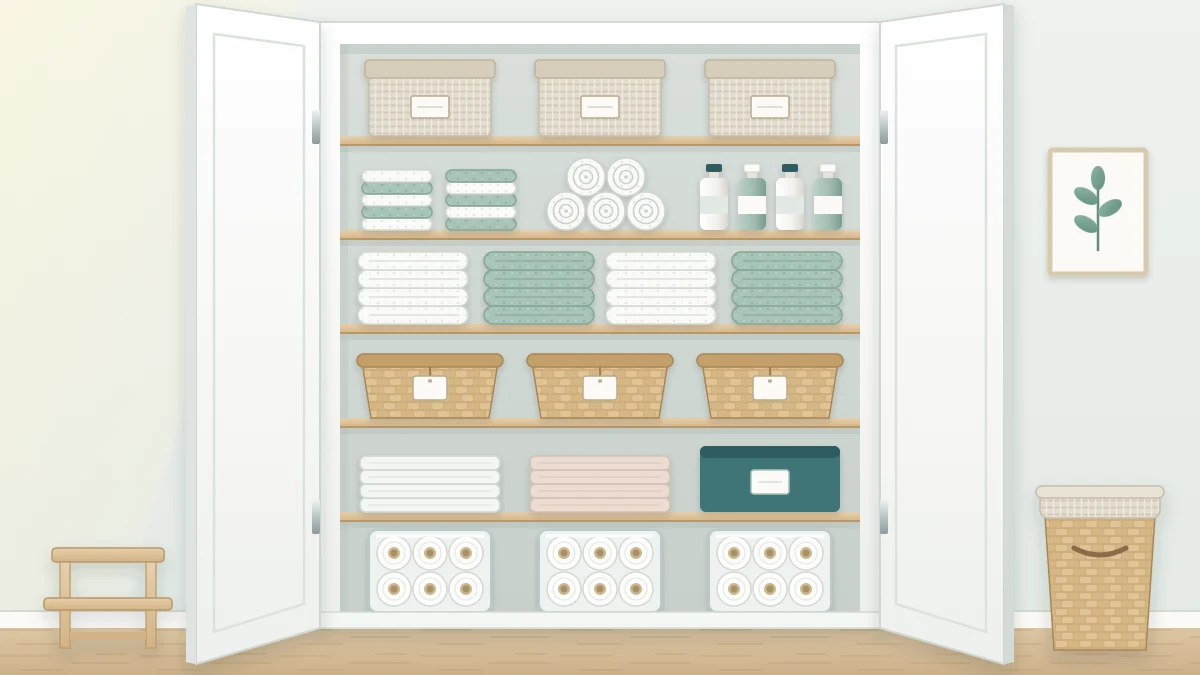
Eight ordered steps for a linen closet or tall bathroom cabinet: empty and sort, decide what stays, assign shelves by reach, fold towels to the shelf depth, contain small items and keep it tidy on laundry day.
At a glance
What you need
- Tape measure
- Cloth for wiping shelves
- Bins or baskets, one per category
- Shelf dividers
- Labels and a pen
- A box for items that belong elsewhere
A linen closet fails in predictable ways. Towel stacks lean and topple, small things get pushed to the back, and backups vanish behind the sheets until you have bought them twice. The closet is rarely too small; it simply has no plan.
The steps below show how to organize a bathroom linen closet from empty shelves to a layout that stays put. They work the same way for a tall bathroom cabinet. Set aside part of a day, and do the steps in order.
Step 1: Empty the closet and sort
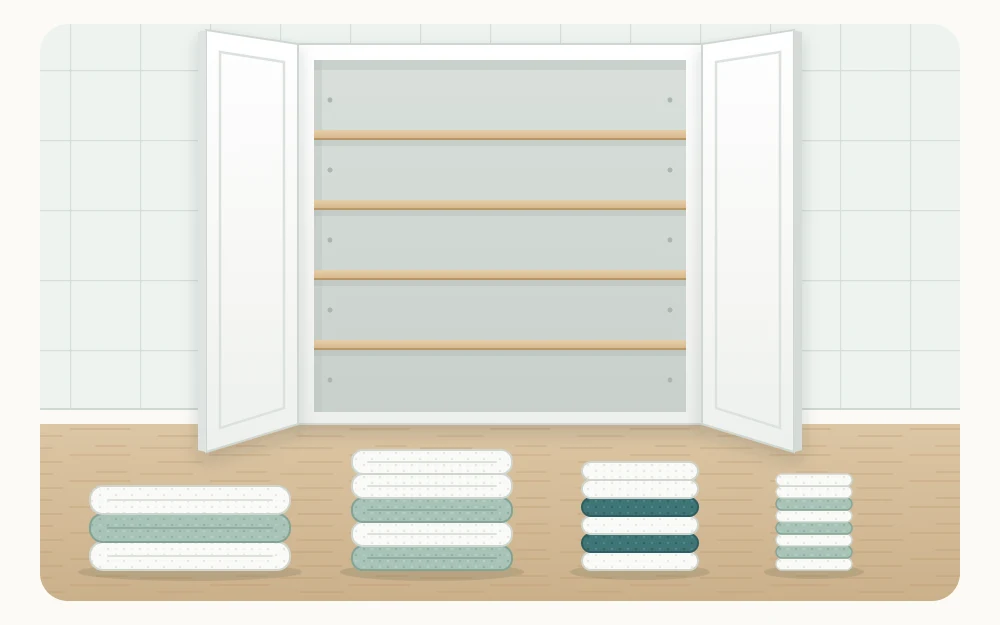
Take everything out, one shelf at a time, and sort as you go so you never face a single huge pile. Use the floor, a bed or a table and make a group for each category:
- Towels, split by size: bath towels, hand towels, washcloths
- Sheets, if they live here
- Backup toiletries
- Paper goods: toilet paper, tissues
- First-aid supplies
- Cleaning supplies
- Guest items
Anything that belongs in another room goes into a box by the door to deliver later.
Step 2: Decide what stays
With every category in view, decide how many of each you actually need. There is no universal number. A workable starting point is to count how many towels your household uses between laundry loads and add a small margin, plus a set for guests.
Set aside towels that are worn thin or frayed. They can become cleaning rags stored elsewhere, or be passed on; many animal shelters accept old towels. Do the same with backups: keep what you will use and pass on unopened extras you will not.
Step 3: Wipe the shelves and let them dry
While the closet is empty, wipe each shelf and the floor, then leave the door open until every surface is completely dry. This is also the moment to adjust shelf heights if your closet allows it, and to note the depth and width of each shelf if you plan to add bins. Shelf liner is optional; if you use it, follow its instructions.
Step 4: Assign shelves by reach
The best shelf is the one between your shoulders and your waist. Give it to the things you take out most, and work outward from there.
| Shelf | What goes there | Container |
|---|---|---|
| Top | Rarely used and guest items | Lidded bins |
| Just above eye level | Hand towels, washcloths | Stacks or an open basket |
| Eye level | Everyday bath towels | Stacks with shelf dividers |
| Just below | Daily backups, first-aid supplies | Labeled bins, one category each |
| Bottom shelf or floor | Bulky paper goods, a hamper | Large open basket or none |
Treat the table as a starting point and adjust it to the number of shelves you have. Sheets, if they share the closet, usually take a shelf of their own just above or below the towels. Guest items stored on the top shelf are easier to manage if you keep them as a ready set; the guide to setting up a guest bathroom lists what to include.
Good to know
If cleaning supplies are stored here, they stay in their original labeled containers, on a high shelf or in a secured cabinet, away from children. A lock or latch is an extra layer, not a substitute for keeping products out of reach.
Step 5: Fold towels to the shelf depth
Stacks topple when the towels in them are different sizes. The fix is to fold every towel of one kind the same way, to a size that matches the shelf.
- Measure the shelf depth, front to back.
- Fold a bath towel in thirds lengthwise, then fold it across until its length is a little less than that depth.
- Check the fit, then fold every bath towel the same way.
- Place each stack with the smooth folded edge facing out.
Keep stacks low enough that you can lift the top towel without disturbing the rest; four to six bath towels is typical, depending on thickness. For rolled towels, hooks and other options outside the closet, see these towel storage ideas.
Step 6: Contain the small things
Anything smaller than a hand towel needs a container, or it will drift. Use one bin per category and label the front, so every member of the household can find things and, more to the point, put them back.
- Backup toiletries: one bin, grouped by type with the next-to-use at the front. The guide to organizing toiletries and backups explains how to cap the number of spares.
- First-aid supplies: one lidded box, easy to carry to where it is needed.
- Washcloths: an open basket, filed upright so you can take one without unstacking.
- Guest items: one lidded bin on the top shelf.
Measure before buying anything, and pick containers that fill the shelf depth so nothing hides behind them. If you are choosing between woven, wire, fabric and plastic, the guide to baskets and bins for bathroom storage compares them.
Step 7: Add dividers and leave some air
Shelf dividers are upright panels that clip or slide onto a shelf. Placed between stacks, they stop one stack from leaning into the next and make each stack’s space obvious. Fit them as their instructions direct for your shelf type and thickness.
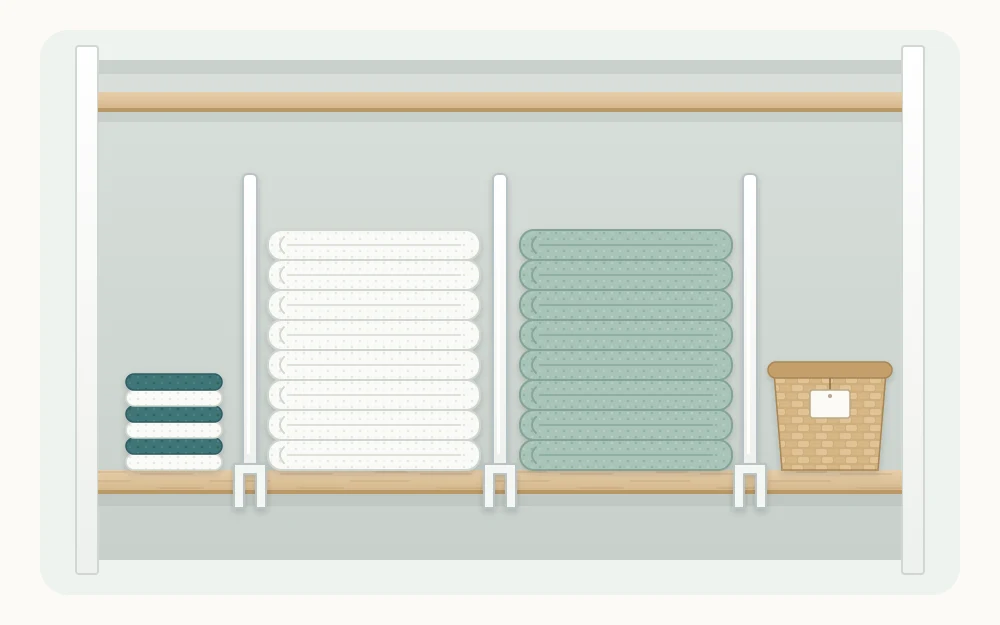
Resist filling every gap. Leave a little air around stacks and a finger-width between a stack and the shelf above. A closet that is full to the edges is hard to put things back into, and that is where the mess starts again.
One rule applies every time: towels and sheets go in only when they are fully dry.
Step 8: A five-minute reset on laundry day
The closet stays organized if you tidy it at the moment things go back in. Each time you put laundry away:
- Square up each stack and turn the smooth edges out.
- Put clean towels at the bottom of the stack, so the whole set gets used in turn.
- Return anything that has wandered to its bin.
- Glance at the backup bin and the paper goods, and add anything low to your shopping list.
Tip
If one category keeps overflowing its bin, do not start a second bin. Either trim the category or swap shelves with something that needs less room.
Frequently asked questions
How many towels should I keep in a linen closet?
There is no fixed number. As a starting point, count how many towels your household uses between laundry loads, add a small margin and include a set for guests. If the stacks no longer fit on their shelf with a little air around them, that is a sign to trim.
How do I stop towel stacks from falling over?
Fold every towel of one kind to the same size, matched to the depth of the shelf, and keep each stack low enough to lift the top towel easily. Shelf dividers between stacks, fitted as their instructions direct, give each one its own lane so it cannot lean into its neighbor.
What should go on the top shelf of a linen closet?
Things you reach for least: guest items, seasonal linens and rarely used extras, kept in lidded bins with a label on the front. Bins with handles are easier to bring down. Keep everyday towels at eye level and bulky paper goods at the bottom.