Toiletry Organization: Sorting, Containing and Storing Backups
A simple system for every toiletry in the bathroom: sort by routine, split what is in use from unopened backups, give each category one container and keep spares in a single backup zone.
Toiletries spread because they are small, bought often and rarely given a fixed home. A new bottle lands on the nearest flat surface, a spare slides to the back of a cabinet, and a few weeks later you buy a third tube of something you already own twice.
Good toiletry organization does not depend on special containers. It depends on three decisions made in order: what the categories are, which items are in use and which are backups, and where each group lives. Once those are settled, almost any bin, cup or drawer section will do the job.
Sort by routine, not by container shape
Grouping by looks, with all the tall bottles together and all the tubes together, is neat for a day and then fails. Nobody reaches for “a tube”. You reach for what you need to brush your teeth or wash your hair.
Gather every toiletry in the room onto a towel on the floor or the counter, then sort into categories that match what you actually do:
- Dental: toothpaste, toothbrushes, floss, mouthwash.
- Hair: shampoo, conditioner, styling products, brushes and combs.
- Body: body wash, soap, lotion, deodorant.
- Face: cleansers, moisturizers and whatever else belongs to your face routine.
- Shaving: razors, spare cartridges, shaving cream.
- Travel sizes and samples.
- First-aid supplies: adhesive bandages, gauze, tape.
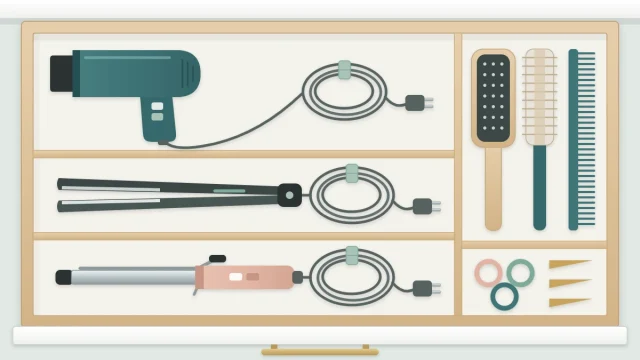
Adjust the list to your household. If one category is much bigger than the rest, it may deserve its own plan: there are separate guides to arranging skincare by routine step, to storing dryers, irons and brushes and to setting up a makeup drawer.
Split every category into “in use” and “backup”
This is the step that stops duplicates from hiding. Within each category, make two piles:
- Open and in use: the one bottle, tube or pack you are working through now.
- Backups: unopened spares waiting their turn.
The two piles get different homes. Items in use live at the point of use: the toothpaste near the sink, the shampoo in the shower, the lotion wherever you put it on. If you have not yet decided which spot serves which task, the guide to mapping daily-use zones walks through it.
Backups do not go next to their open twin. They all go together in one backup zone, which is covered below. If you find two half-used versions of the same thing, pick one to finish first.
Give each category one container
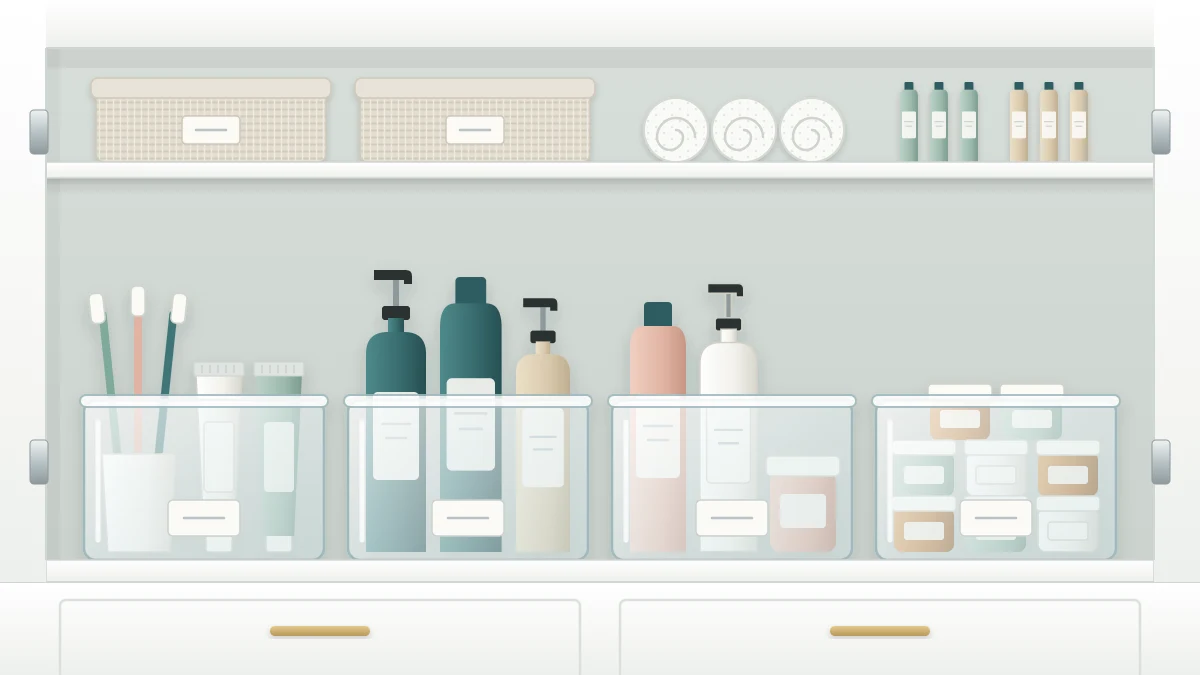
The rule is simple: one category, one container. That container can be a bin on a cabinet shelf, a section of a drawer, a basket, or a single shelf of the medicine cabinet. What matters is that it has edges, so the category cannot drift into its neighbor.
- Use open bins for things you grab daily, so nothing has to be unlidded first.
- Put small loose items such as floss, hair elastics, cotton swabs and razor cartridges in cups or small lidded boxes inside the larger bin.
- Stand bottles upright rather than laying them down.
- Turn labels to face out, so you can read what something is without picking it up.
If a category will not fit in its container, either trim it or give it a bigger home. A second, overflow bin somewhere else is how things get lost again.
Set up one backup zone
A backup zone is a single place where every unopened spare in the bathroom lives. One shelf, one large bin or one deep drawer is usually enough. A linen closet shelf or a hallway cabinet works just as well if the bathroom is small.
Inside the zone:
- Group by type, so all the toothpaste is together and all the soap is together.
- Put the next-to-use item at the front and new purchases behind it.
- Keep everything visible from the front or from above. Clear bins or a shelf riser help with a deep shelf.
Two habits keep the zone honest. First, look in it before you shop, or take a quick picture of it on your phone. Second, set a cap. One backup per product is a reasonable starting point for most households: when you open the spare, that product goes on the shopping list. Larger households may prefer two. The exact number matters less than having one.
Contain travel sizes and samples
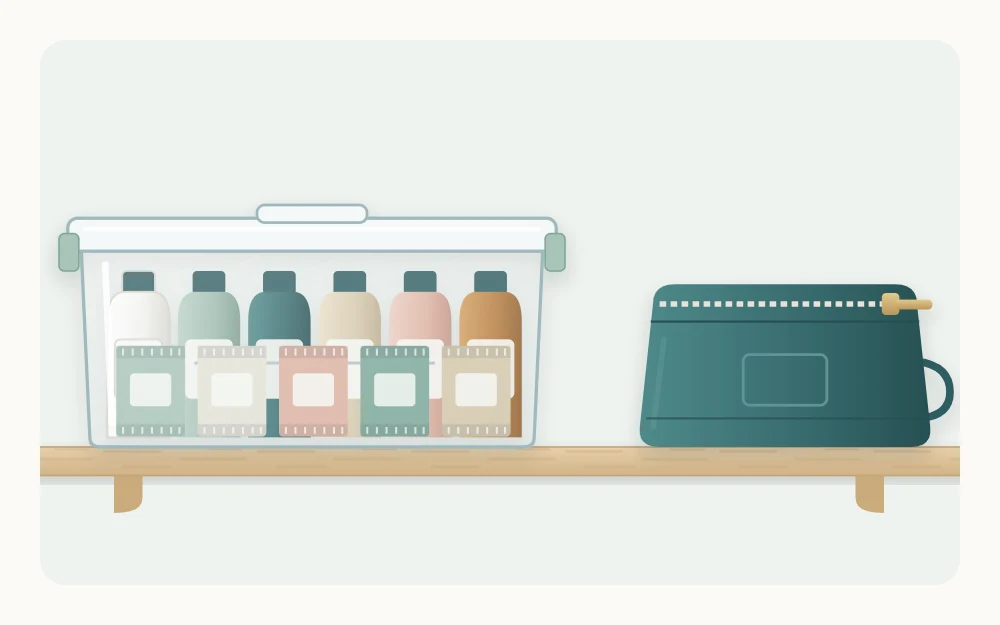
Miniatures multiply quietly. Give them a single limit container, such as one lidded box, and let the box set the rule: when it is full, nothing new goes in until something is used up or passed on.
If you travel regularly, a second option is a travel pouch kept packed and ready. Refill it when you get home, and anything that does not fit in the pouch or the box does not stay.
Store tall bottles, pumps and tubes so they stay put
Awkward shapes cause most of the tipping and leaking in a toiletry cabinet. A few adjustments help:
- Tall bottles: use a bin with sides at least half the bottle’s height, or a narrow bin that holds a single row so each bottle is supported by its neighbors.
- Pump bottles: measure the height with the pump on top before choosing a shelf. Twist the pump to its locked position, if it has one, when the bottle is in storage.
- Tubes: stand them cap-down in a cup or a narrow compartment so they do not slide around a drawer.
- Anything that has leaked before: stand it in a small tray or a bin with a solid base that can be lifted out and wiped.
Check that every cap is fully closed before an item goes back.
Good to know
Products differ. Where a label or package gives storage directions, follow them and choose a spot that matches, even if that spot is outside the bathroom.
Shared bathrooms: one bin per person
In a shared household, some toiletries belong to everyone and some are personal. Keep the shared categories as they are, such as hand soap, toothpaste and first-aid supplies. Then give each person one bin, caddy or drawer section for the things only they use.
A personal bin also makes the counter easy to clear: each bin goes back to its shelf, and the surface is empty. Different colors, or a tag on the handle, tell the bins apart.
Keep it working
When something is used up, open its backup and add the product to your list. When you unpack shopping, new items go to the back of the backup zone, not onto the counter. Every so often, return strays to their bins.
Frequently asked questions
How many backup toiletries should I keep?
There is no single right number. One unopened backup per product is a reasonable starting point for many households, and larger households may prefer two. What matters is choosing a cap and sticking to it: when you open the spare, add the product to your shopping list and buy one replacement.
Where should backup toiletries go in a small bathroom?
Keep them together in one place, even if that place is outside the bathroom. A linen closet shelf, a hallway cabinet or a lidded bin on a high shelf all work. Group the spares by type, put the next-to-use at the front, and check the zone before you shop.
What is the best way to store travel-size toiletries and samples?
Give them one limit container, such as a single lidded box, and let its size set the rule. When the box is full, nothing new goes in until something is used up or passed on. Frequent travelers can keep a packed pouch ready as well and refill it after each trip.