Makeup Drawer Organization by Category and Frequency
Organize a makeup drawer in two passes, first by category and then by how often you use each item, with compartment ideas for pencils, compacts, brushes and palettes.
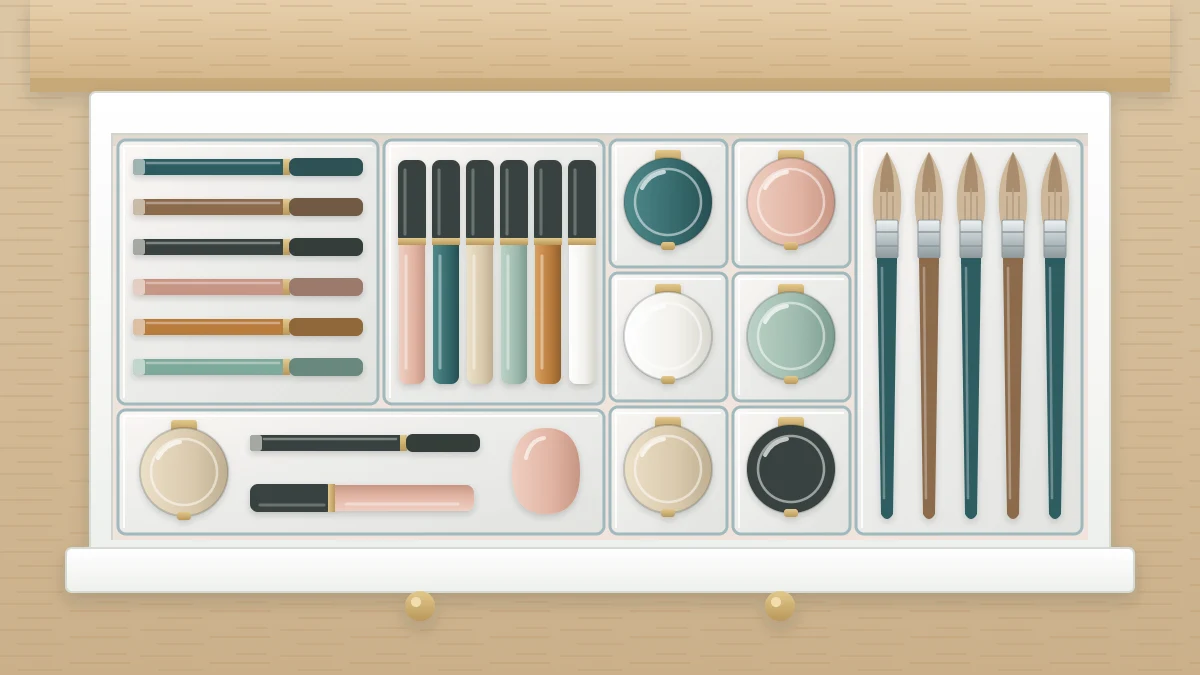
A makeup drawer is hard to keep in order because its contents are small, round and numerous. Pencils roll, compacts slide, and after a week of opening and closing, everything has settled into one rattling layer where the item you want is always under three others. Makeup drawer organization fixes this with compartments, but the compartments only work if they follow how you actually use what is in them.
The method here takes two passes. First you sort by category, so similar things sit together. Then you sort by frequency, so the handful of products you use every day are in front and everything else is behind them.
Why a shallow drawer suits makeup
Makeup items are short. In a shallow drawer they lie in a single layer, every one visible from above, and a single visible layer beats a deep pile every time. If you can choose which vanity drawer to use, pick the shallowest one that is close to the mirror.
A deeper drawer can still work, but it needs a different approach, covered further down. Either way, start by emptying the drawer completely and wiping it out.
Pass one: sort by category
Lay everything on a towel and make four groups:
- Face: foundation, concealer, powder, blush, bronzer.
- Eyes: shadows, liners, mascaras, brow products.
- Lips: lipsticks, glosses, lip pencils.
- Brushes and tools: brushes, sponges, tweezers, a sharpener, a lash curler.
As you sort, pull out empties, duplicates and anything you have not reached for in a long time. If the amount to let go of is large, the guide on how to declutter a bathroom gives a calm way to work through it. Daily face creams and similar products follow different storage logic and have their own guide to skincare storage.
Pass two: sort by frequency
Within each group, set aside what you use on an ordinary day. For many people this is a short list: one base product, one mascara, one brow product, one lip color and two or three brushes.
Keep that everyday set together in a compartment of its own at the very front of the drawer, even though it mixes categories. The whole routine then uses one compartment, and you can get ready with the drawer only partly open. Occasional items go behind it, arranged by category.
Tip
Not sure what counts as everyday? For one week, put each product you use into a small dish instead of back in the drawer. Whatever is in the dish at the end of the week is your everyday set.
Compartment ideas that fit makeup shapes
Makeup comes in a few repeating shapes, and each has a compartment that suits it:
- Narrow lanes for pencils, liners and mascaras, laid side by side with the color end or label facing the same way.
- Small squares for compacts, single shadows and pots, one or two per cell so they cannot slide over each other.
- A brush lane long enough for your longest brush, so the bristles lie straight and are not bent against a wall.
- An upright cup for brushes, if the drawer is tall enough to close over them.
- A lidded section for loose small items such as a sharpener, hair pins or spare sponge tips.
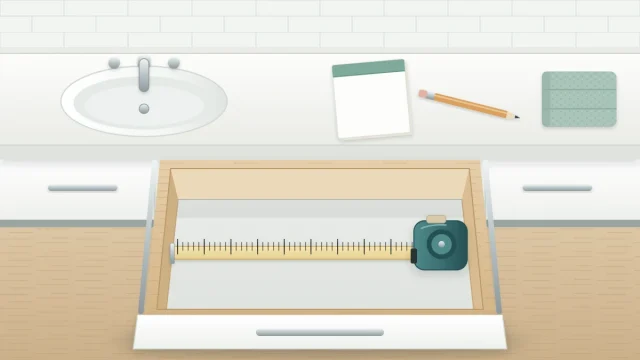
Modular trays suit this well because you can combine long and square pieces. Measure the inside of the drawer before you buy, and fit the trays edge to edge so they stay still. The general rules for sizing and placing compartments are in the guide to bathroom drawer layout and dividers.
Clear trays and a wipeable liner
Two material choices make a makeup drawer easier to live with. Clear trays let you see product color through the sides, which helps when lipsticks or pencils lie with their ends hidden. They also show spills right away.
A wipeable liner on the drawer floor catches loose powder and smudges before they reach the drawer itself. Cut it to size and lay it under the trays. At each reset, lift the trays out, wipe them and the liner, and let both dry before putting everything back.
A limit container for samples
Samples and minis multiply quietly and are the usual reason a tidy drawer fills up again. Give them one small container and treat its size as the limit. When it is full, a new sample goes in only after another one has been used or let go.
Keep the sample container behind the everyday compartment, where you will see it but not have to reach over it. If it never gets opened, that tells you how many samples you really need to keep.
Palettes on edge in a deeper drawer
Flat palettes are the one makeup shape that stacks, and a stack hides everything but the top one. In a deeper drawer, stand them on edge between dividers, like files, with the hinge side down. You can then flip through them and lift out the one you want without disturbing the others.
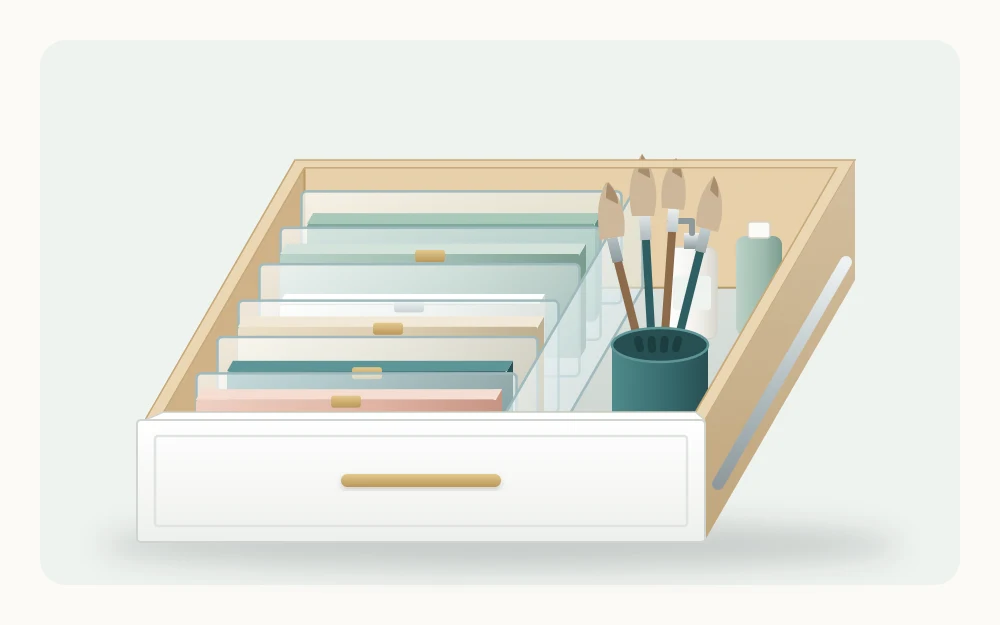
The same deeper drawer has room for a brush cup and for taller bottles standing upright. Use dividers snug enough that the palettes cannot tip when the row is not full, and check that each one closes securely before it goes in on its edge.
Dates and condition
Organizing is a good moment to look at what you are keeping. Follow any date printed on a package, and look for the small open-jar symbol that some products carry to show a period after opening. Replace any product whose smell, color or texture has changed, whatever its packaging says. For more detail, see the FDA’s page on shelf life and expiration dating of cosmetics.
Products differ, so store each one as its own label or package directs. If you want to remember when you opened something, a small sticker with the date on the base is enough.
After that, upkeep is brief. Return each item to its compartment as you finish with it, and when a compartment starts to overflow, take that as the signal to edit its contents, not to add another tray.
Frequently asked questions
How should I arrange makeup in a drawer?
Group it by category first: face, eyes, lips, brushes and tools. Then pull out the few products you use on an ordinary day and give them their own compartment at the front. Occasional items sit behind, by category, in lanes and small squares sized to their shapes.
What is the best way to store makeup palettes?
In a shallow drawer, lay them flat in a single layer. In a deeper drawer, stand them on edge between snug dividers, like files, so you can flip through and lift one out without unstacking the others. Check that each palette closes securely before filing it.
How do I know when to let go of a makeup product?
Follow any date or period-after-opening symbol printed on the package, and replace a product whose smell, color or texture has changed. Products differ, so the package is the place to look. The FDA publishes general information on cosmetic shelf life and expiration dating.