Bathroom Drawer Organization: Dividers, Trays and Layout
How to lay out a bathroom drawer so it holds: one job per drawer, compartments sized to categories, four divider types compared, and an edge-to-edge fit.

A bathroom drawer turns into a junk drawer for a predictable reason: it is an open box, and small things slide to wherever the last push sent them. Good bathroom drawer organization replaces that open box with a layout, meaning fixed compartments, each sized for one category, that stay put when the drawer opens and closes.
The layout comes before the containers. Decide what each drawer is for and how its floor should be divided, and only then choose the dividers or trays that produce that plan. Done in this order, the result tends to hold for a long time with very little effort.
Give each drawer a job
Start with the stack as a whole. A drawer that holds a bit of everything cannot be laid out, so assign one role per drawer. As a starting point for a typical three-drawer vanity:
- Top drawer: daily grooming. Toothpaste, floss, a comb, a razor, the things used every morning and night.
- Middle drawer: one larger category, usually hair items such as brushes, clips and ties, or makeup.
- Bottom drawer: backups and bulky items that are needed less often.
With two drawers, combine the first two roles. With one, it becomes the daily drawer and everything else moves to the cabinet. If the middle drawer is for makeup, it has enough detail of its own to deserve a separate plan, described in the guide to organizing a makeup drawer by category and frequency.
Lay out the inside
Empty the drawer, wipe it, and sort what belongs in it into categories on the counter. Each category gets one compartment, sized to the amount you actually keep. Then place the compartments using two rules:
- Small items at the front. The front few inches are visible even when the drawer is only half open, so small, frequently used things go there.
- Long items along a side. Combs, toothbrush boxes and tubes lie front to back in a narrow lane against one side, which leaves the remaining floor free for squarer compartments.
The back of the drawer is the least convenient part. Use it for the category you reach for least, not for anything in the daily routine.
Divider types compared
Four kinds of divider cover almost every bathroom drawer. They can be mixed, and many good layouts use two of them together.

| Type | What it suits | The catch |
|---|---|---|
| Modular trays | Many small categories; layouts you may want to rearrange later. | Sizes rarely add up exactly to the drawer, so plan the combination on paper first. |
| Expandable spring-loaded dividers | Long lanes for larger items; drawers of unusual width. | They make lanes, not small cells, so tiny items still wander within a lane. |
| Fitted cutlery-style tray | A standard-width top drawer with long, slim items. | Fixed compartments; a gap at the side or back is common. |
| Small open boxes | Odd corners, single categories, filling gaps beside other trays. | They slide unless they are packed in tightly or set on a liner. |
Whatever you choose, pick a material that wipes clean and has no fabric lining, since bathroom drawers collect drips and powder.
Fill the footprint edge to edge
The single most common reason a tidy drawer comes undone is trays that move. If a tray can slide, it will, and every gap beside it becomes a place where loose items collect. Aim to cover the whole floor of the drawer, wall to wall and front to back, so each piece is held in place by its neighbors.
Where a small gap is unavoidable, a non-slip liner under the trays keeps them still. Cut the liner to the drawer floor and lay it flat before the trays go in. A narrow leftover strip can also be put to use as a lane for one long item.
Tip
Before buying, arrange boxes or lids you already own in the drawer to test the plan. A few days of use shows which compartments are too small while changing them is still free.
Leave a little slack
Tight between trays, loose inside them. A compartment packed to its limit works only until one new item arrives, and then things start resting on top of the dividers. Leave some spare room in each compartment so that returning an item never takes two hands.
Keep everything in one visible layer
You look into a drawer from above, so anything underneath something else is effectively hidden. Store items in a single layer, or upright where the drawer is tall enough, with nothing stacked. Tubes can stand on their caps in a snug compartment; flat items lie side by side instead of in a pile.
If a category will not fit in one layer, that is useful information. Either the compartment needs to be bigger, or some of that category is surplus and belongs with the backups in the bottom drawer.
Shallow versus deep drawers
Shallow drawers are the easy ones, because a single layer is all they can hold. Deep drawers tempt you to pile, and they need taller bins and upright storage to stay visible from above; that approach has its own guide to organizing deep bathroom drawers.
Measure before you buy
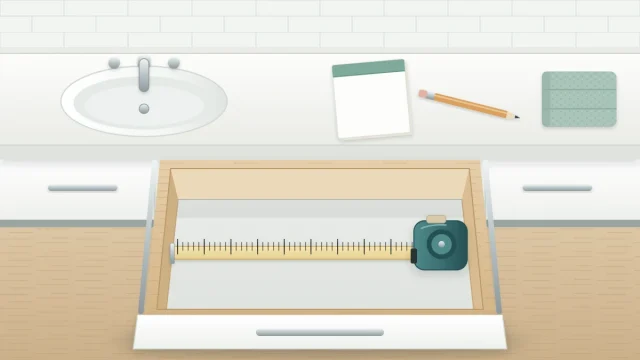
Organizers that almost fit are the most expensive kind, because they get replaced. The inside of a drawer is smaller than its front suggests, and slide hardware or a rounded corner can take away more. Take the inside dimensions first, following the step-by-step guide on how to measure bathroom drawers for organizers, and bring those numbers with you when you compare sizes.
Wipe when you reset
A laid-out drawer needs little upkeep, but it is not sealed. Now and then, lift the trays out, wipe each one and the liner beneath, and let everything dry before it goes back. This is also the moment to return strays to their compartments and remove empties.
If one compartment is always overflowing or always empty at reset time, change its size. A layout is meant to be adjusted as your routine changes, and modular pieces make that a two-minute job.
Frequently asked questions
What is the best way to organize bathroom drawers?
Give each drawer one job, then divide its floor into compartments sized to the categories it holds. Small daily items go at the front, long items along one side, and everything sits in a single visible layer. Fill the drawer edge to edge so the trays cannot shift.
Are modular trays or expandable dividers better for a bathroom drawer?
They do different jobs. Modular trays make small cells for small categories and can be rearranged. Expandable dividers make long lanes and adapt to unusual drawer widths, but small items still wander inside a lane. Many drawers work well with a mix of the two.
How do I stop drawer organizers from sliding around?
Cover the full floor of the drawer so each tray is held by the ones next to it. Where a gap remains, lay a non-slip liner cut to the drawer floor under the trays, or fill the gap with a small open box or a lane for one long item.