Deep Bathroom Drawers: How to Organize Tall Items and Backups
Deep vanity drawers fail in two ways: bottles tip over and small things get buried. Here is how to keep tall items upright, use the top half of the drawer and store backups in rows.
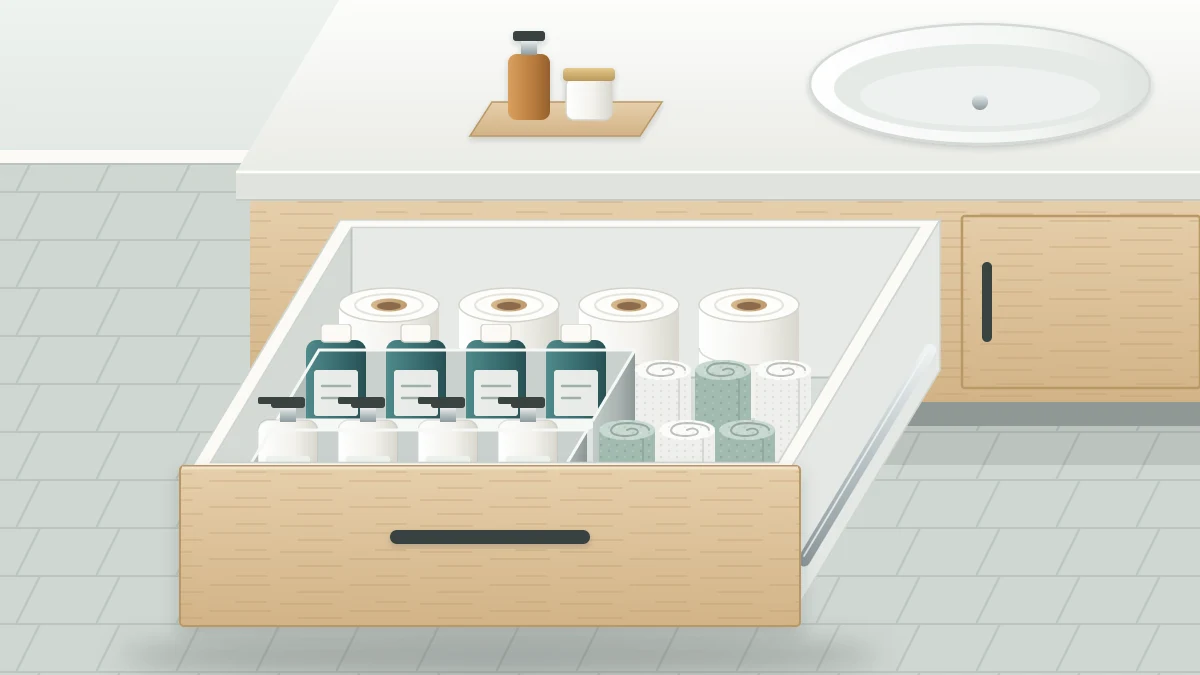
A deep vanity drawer looks like the most generous storage in the room, and it is often the least useful. Bottles tip over every time it opens, small things sink to the bottom, and within a month the drawer is a single loose layer of everything. Deep bathroom drawer organization is mostly about fixing those two problems: things that fall, and things that get buried.
The good news is that a deep drawer needs very little equipment. It needs the right contents, a few tall-sided containers and one decision about how to use the upper half of the space.
What a deep drawer is for
Shallow drawers suit small, flat things that you want to see in a single layer. Deep drawers suit the opposite: tall and bulky items that waste space or will not fit anywhere else. As a starting point, a deep drawer is a good home for:
- Bottles and pump dispensers standing upright
- Hair tools and their attachments
- Backups, meaning unopened spares of what you already use
- Spare rolls of toilet paper
- Folded washcloths and hand towels
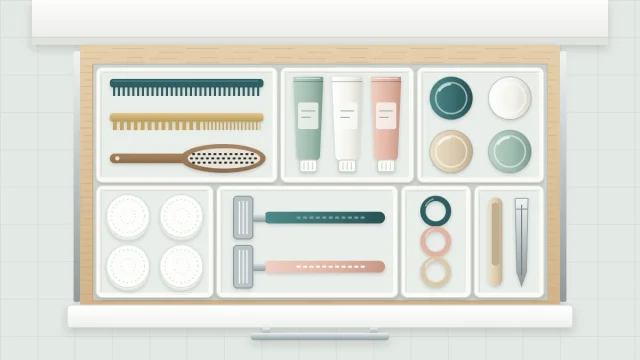
Small loose items such as hair ties, cotton swabs and nail clippers do not belong on the floor of a deep drawer. They either move to a shallow drawer or ride in a tray near the top, as described below. For the general layout of shallow and mixed drawers, see the main guide to bathroom drawer organization.
The two ways deep drawers fail
Tipping and sliding. A tall bottle on a smooth drawer floor has nothing to lean on. Each time the drawer opens or closes, it slides, knocks into its neighbors and eventually lies down. Bottles lying on their sides take more floor space and are harder to tell apart.
Burying. Height invites stacking. Small items land on top of big ones, then slip down between them, and soon you are lifting out three things to reach a fourth.
Keep bottles upright in rows
Bottles stay standing when something tall is holding them on at least two sides. Low trays that work in a shallow drawer do very little here, because the bottle simply tips over the rim.
Look for bins or dividers whose sides reach roughly halfway up your tallest bottles. Narrow rectangular bins work well because they turn the drawer into rows: one row for hair products, one for body products, one for backups. Deep adjustable dividers do the same job.
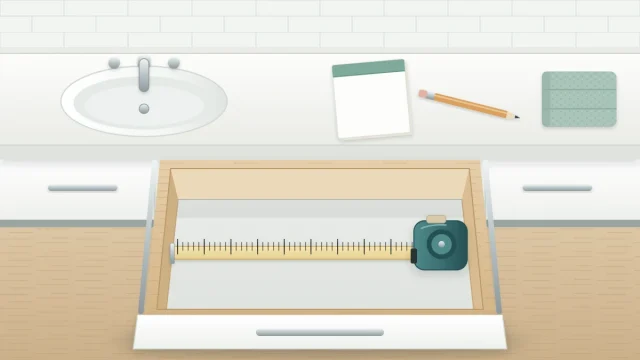
Fill each row so that the bottles support one another, and close up any gap with a smaller bin so the row cannot slide. Measure the inside of the drawer before buying anything, including the usable height.
Tip
Choose open bins that lift out. Carrying a whole category to the counter is easier than digging through the drawer, and an empty drawer is quick to wipe.
File-fold soft items
Washcloths and hand towels stacked flat have the same burying problem as everything else: you only ever use the top one, and the stack collapses when you pull from the middle. Folding each piece into a compact rectangle and standing it on its folded edge, like files in a box, shows every item at once.
A tall-sided bin or a divider keeps the row from falling over as it empties. Soft items also make good filler beside a row of bottles, since they take up whatever width is left.
Use the upper half with a top tray
Most of what goes in a deep drawer is shorter than the drawer is tall, which leaves empty air above it. A shallow tray that sits on top claims that space for small things without covering the tall ones.
There are two common forms. A sliding tray rests on the drawer sides or on its own rails and moves from front to back, so you push it aside to reach what is underneath. A stacking tray sits on top of the bins below and lifts out. Either way, the tray should cover about half the drawer at most, so that tall bottles can stand in the open half at full height.
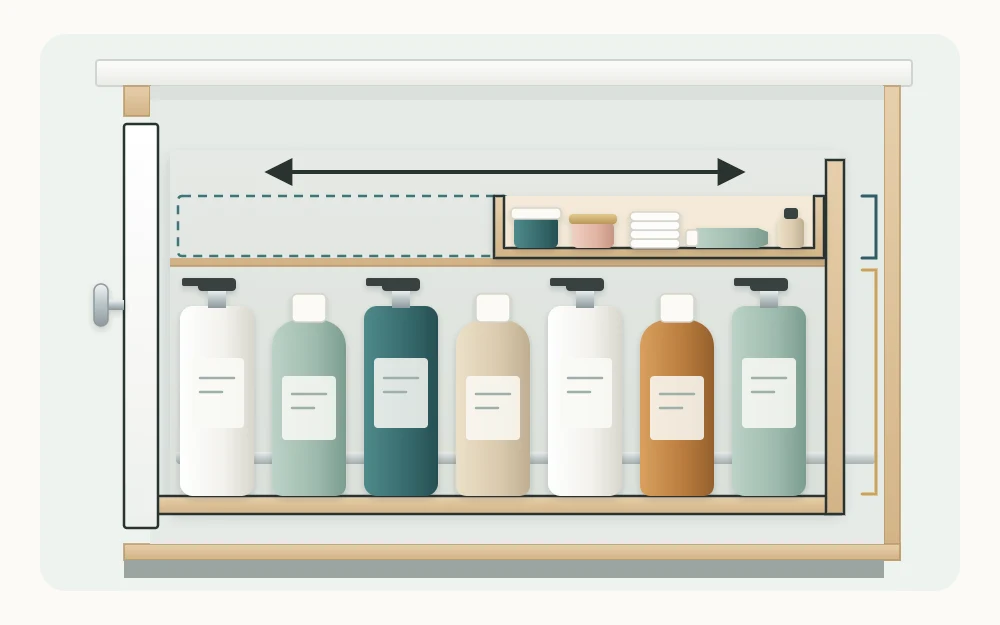
Put daily small items in the tray and the things you reach for less often underneath it. If you find yourself moving the tray many times a day, the items below it probably deserve a more accessible home; the guide to organizing toiletries covers how to sort products by how often they are used.
Place weight low and toward the back
A full deep drawer can be heavy, and where the weight sits affects how it runs. Large full bottles and bulk backups go on the drawer floor and toward the back, close to where the slides carry the load. Light things, such as toilet paper and washcloths, can go anywhere, including the front.
Good to know
If the vanity or drawer maker gives a load limit for the drawer, stay within it. A drawer that sags, sticks or drops when opened is overfilled; move part of its contents elsewhere.
A drawer with a cutout around the sink
The top drawer of a sink-base vanity is often built with a U-shaped cutout so that it clears the drain. What remains is two side wings joined by a narrow strip at the front. This shape is awkward for wide items and surprisingly good for tall ones.
Treat each wing as its own small deep drawer. Stand bottles in a narrow bin in each wing, one category per side, and use the front strip for short things such as a comb or a tube lying flat.
Backups and hair tools
Backups are what deep drawers hold best, and also what turns them into a jumble. Give each product type a single row: all the spare toothpaste together, all the spare soap together. A row is the limit. When it is full, you have enough.
Put the oldest item at the front of each row and add new purchases at the back, so stock is used in the order it arrived. Follow the storage directions on each label.
A deep drawer also has the room that dryers and styling irons need. Tools go into the drawer only when they are unplugged and have cooled completely as their manual describes; the guide to hair tool storage explains the options in detail.
Once the drawer is set up, open and close it a few times at normal speed. If nothing tips and you can see every category from above, the layout is working.
Frequently asked questions
How do I stop bottles from falling over in a deep drawer?
Give them something tall to lean on. Bins or dividers whose sides reach about halfway up the bottles hold them in rows, and filling each row so the bottles support one another stops sliding. A non-slip liner under the bins keeps the containers themselves from shifting when the drawer moves.
What should not go in a deep bathroom drawer?
Small loose items placed directly on the drawer floor, because they end up buried under larger things. Move them to a shallow drawer or to a tray that sits near the top of the deep one. Hair tools that are still warm or plugged in also stay out until they have cooled fully and are unplugged.
Is a sliding tray or a stacking tray better for a deep drawer?
It depends on the drawer and on how often you need what is underneath. A sliding tray moves aside with one hand, which suits items below that you use often. A stacking tray lifts out and needs no rails, which suits drawers of unusual size. In both cases, cover no more than about half the drawer.