Renter-Friendly Bathroom Storage Without Drilling
No-drill bathroom storage by type: freestanding, tension-mounted, over-the-door, adhesive, suction and magnetic, with what each one suits, the surface it needs and its limit.
Renting usually means the bathroom came as it is: tiled walls you cannot drill, a vanity you cannot change and less storage than you need. Renter-friendly bathroom storage works within those limits by standing on the floor, pressing between two surfaces, hooking over a door or sticking to a smooth surface, with nothing fixed into the wall.
Each type has something it does well and a clear limit. Knowing both lets you choose pieces that work now and come with you when you move.
Check the lease first
Before using anything that could mark a surface, read your lease or ask the landlord. Leases differ on adhesive products as well as on drilling, and some finishes mark more easily than others. A short written reply from the landlord is worth keeping.
Freestanding and over-the-door pieces are the least likely to raise questions, which makes them the natural place to begin.
No-drill storage by type
Freestanding storage
Anything that stands on the floor needs no permission and moves out in minutes.
- A slim rolling cart: fits a narrow gap beside the vanity or toilet and rolls out for cleaning.
- A tower or tall narrow shelf unit: a lot of storage on a small footprint.
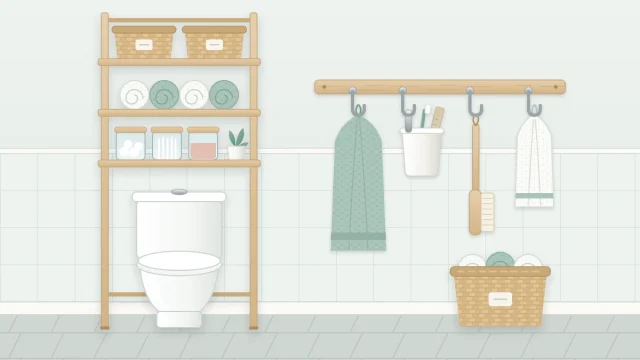
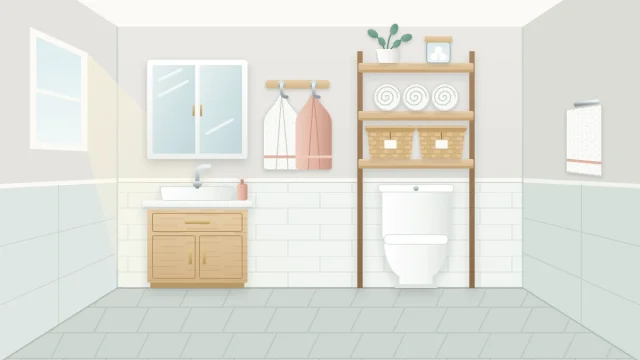
- An over-the-toilet unit: uses the largest empty wall in the room without touching it.
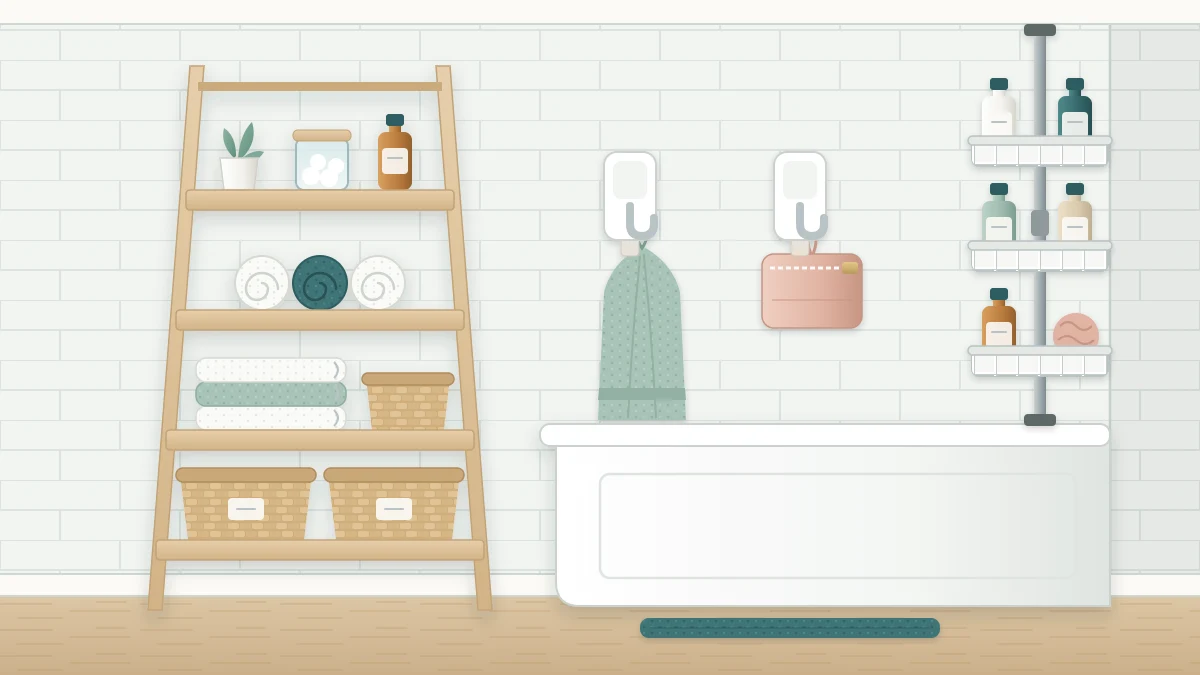
- A ladder shelf: open shelves for baskets and towels.
- A stool: a surface beside the tub with space for a basket underneath.
The limit: floor space. Tall units also need to stand steadily, and their instructions often direct you to anchor them to the wall, which is a question for your landlord. If your sink has no cabinet at all, the guide to pedestal sink storage covers freestanding pieces that fit around it.
Tension-mounted storage
Tension products press outward between two opposite surfaces and stay in place by friction.
- A tension pole caddy: runs between the tub edge or floor and the ceiling, with several shelves.
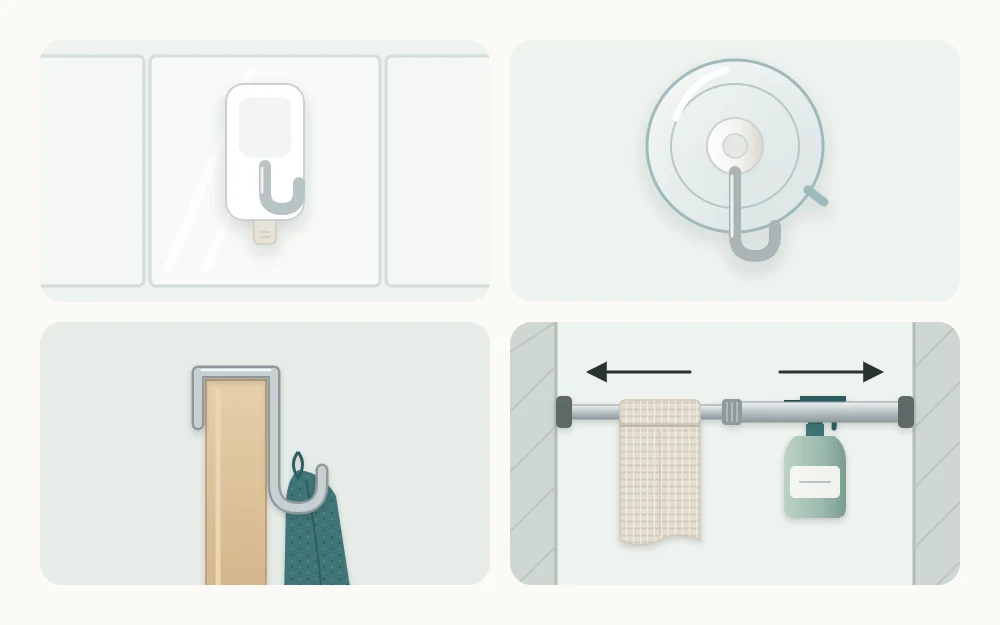
- A tension rod: inside a cabinet for hanging light items, or across a niche.
- A tension shelf: spans an alcove or the space between two walls.
The limit: both surfaces must be firm, parallel and suitable for the product. Set each one up exactly as its instructions describe and recheck it from time to time. The guide to shower and tub storage compares pole caddies with the other options for the wet zone.
Over-the-door and hanging storage
Hooks and racks that hang over the top of the bathroom door suit towels and robes. Smaller versions hang over a cabinet door and hold a hand towel or a small basket. A hanging caddy does the same job in the shower.
The limit: the door has to close and latch with the hook in place, and the hook should not rub the frame. Hang a shower caddy only from a fitting the caddy’s maker says it is designed for.
Adhesive, suction and magnetic storage
Adhesive hooks, strips and small shelves stick to a smooth surface and suit light, single items: a hand towel, a brush, a small pouch. Suction cups do a similar job on very smooth, non-porous surfaces such as glass or glazed tile. Magnetic strips work only where there is metal to hold them, for example inside a metal mirror cabinet, and suit small metal items such as tweezers and nail clippers.
The limit: all three depend on the surface, and each product has a stated limit that includes whatever you hang on it.
No-drill storage types compared
| Type | Holds | Surface it needs |
|---|---|---|
| Freestanding | Towels, baskets, larger items | Level floor space |
| Tension-mounted | Shower bottles, light hanging items | Two firm, opposite surfaces |
| Over-the-door | Towels, robes | A door with clearance to close |
| Adhesive | Light single items | Smooth, clean, dry; as the product lists |
| Suction | Light single items | Very smooth and non-porous |
| Magnetic | Small metal items | A metal surface |
Making adhesive and suction products work
Most failures with these products come from the surface or from rushing, not from the product itself. Four things make the difference.
- Choose the right surface. Check the packaging for the surfaces the product suits. Textured tile, grout lines, wallpaper and some paints are often excluded.
- Start smooth, clean and dry. Prepare the surface the way the instructions describe, and let it dry fully.
- Wait before loading. Many adhesive products need a set time to bond before anything is hung on them. Use the waiting time the instructions give.
- Respect the stated limit. Choose a product rated for what you plan to hang, and do not add to it later.
Good to know
Remove adhesive products the way their instructions describe, not by pulling them straight off, so the surface underneath is not damaged. If the instructions do not list your surface as suitable, choose a freestanding or over-the-door option instead.
Storage that moves with you
The next bathroom will be a different size and shape, so favor pieces that adapt. Modular bins in one repeated size fit almost any shelf or cabinet. A rolling cart works beside a vanity in one home and in a closet in the next. Tension rods and poles adjust in length.
Avoid buying anything cut or sized to fit one exact alcove unless it is inexpensive enough to leave behind. For more ways to use height without fixings, see the guide to vertical bathroom storage.
What to skip
- Heavy loads on adhesive or suction. Full bottles, stacks of towels and glass containers belong on a shelf that stands on the floor.
- Anything hung from the shower head arm, unless the product is designed for that fitting and its instructions say so.
- Storage wedged against plumbing. Carts and bins should sit clear of the shut-off valves so they stay reachable.
- Anything that needs a guess about the lease. If you are unsure, ask before installing, not after.
Start with one freestanding piece and one set of over-the-door hooks. Those two often cover most of what a rental bathroom is missing, and neither leaves a trace when you go.
Frequently asked questions
How can I add bathroom storage without drilling?
Use pieces that stand, press, hook or stick: a slim cart or over-the-toilet unit on the floor, a tension pole caddy in the shower, hooks over the door, and adhesive hooks on a suitable smooth surface. Freestanding and over-the-door pieces are the simplest starting point because they do not touch the walls.
Will adhesive hooks damage a rental bathroom wall?
It depends on the product and the surface. Use them only on surfaces the packaging lists as suitable, and remove them exactly as the instructions describe instead of pulling them straight off. Check your lease or ask the landlord first, since some leases restrict adhesive products as well as drilling.
Do suction cup shelves work on bathroom tile?
They generally need a very smooth, non-porous surface such as glass or glazed tile, and they do not suit textured tile or grout lines. Clean and dry the surface as the instructions describe, respect the stated limit, and keep them for light single items. Recheck them from time to time.