Baskets and Bins for Bathroom Storage: Choosing Materials and Sizes
How to choose baskets and bins for a bathroom: which features suit which job, how five common materials compare, and how to size containers so they fit the shelf and line up.
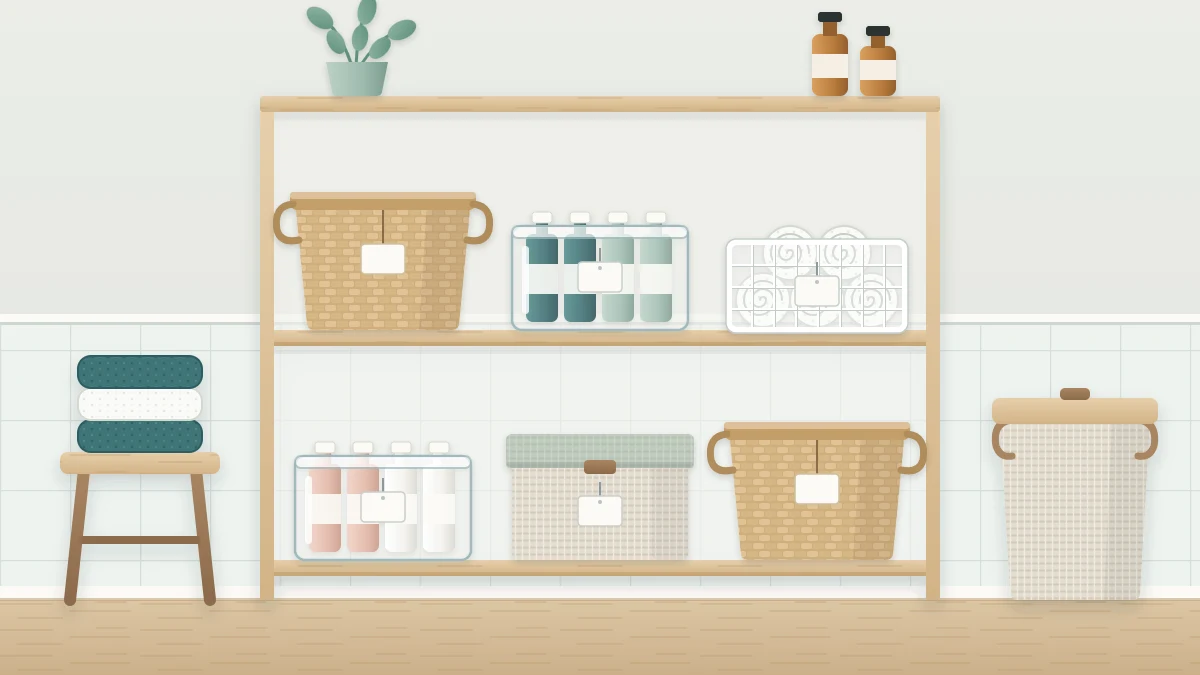
Containers do most of the quiet work in an organized bathroom. They turn a shelf of loose bottles into three or four clear groups, and they make it obvious where each thing goes back. Choosing bathroom storage baskets and bins is mostly a matter of answering two questions: what job does this container do, and where in the room will it sit?
Looks matter too, but they come second. A container that suits its job and its spot will stay in use, and a small, consistent set of materials will make the room look deliberate without much effort.
Start with the job, not the look
Before comparing materials, decide how each container will be used. Five features cover most situations.
- Open: for things you grab every day. No lid means one movement to take an item and one to return it.
- Lidded: for backups and anything you reach for rarely. A lid also hides a mixed group of packages, which calms an open shelf.
- Handled: for anything on a high or deep shelf. A handle lets you pull the whole container down or forward instead of feeling around inside it.
- Clear: for when you need to see the contents at a glance, such as backups you check before shopping.
- Opaque: for when you want visual quiet. The trade-off is that you need a label to know what is inside.
Most containers combine two of these. A clear, open bin suits a cabinet shelf of daily items. An opaque, lidded basket with a handle suits spare paper goods on a top shelf.
Bathroom storage baskets and bins by material
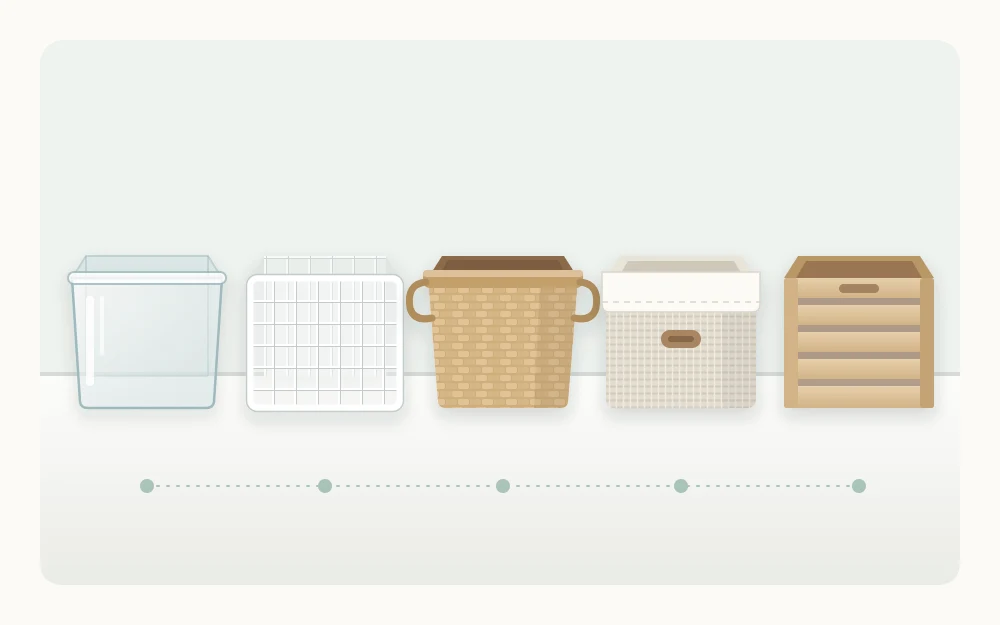
Materials differ in how they look, how they cope with splashes and how easy they are to clean. The table gives general guidance only. Finishes vary a great deal between products, so follow the maker’s care instructions for anything you buy.
| Material | Look | Splashes and cleaning | Best spot |
|---|---|---|---|
| Clear plastic or acrylic | Light and neutral; contents stay visible | Usually simple to wipe or rinse and dry | Inside cabinets, under the sink, near the shower |
| Coated wire | Open and airy; contents partly visible | Generally easy to wipe; check the coating stays intact | Open shelves, towels, larger bottles |
| Woven natural fiber | Warm and textured; hides contents | Generally suits drier spots; usually dusted or brushed | Shelves away from the shower, towels, paper goods |
| Fabric with a liner | Soft and quiet; folds flat when empty | Depends on the fabric; some liners come out for washing | Closed cabinets, linen shelves, light items |
| Bamboo or wood | Natural and structured | Unsealed wood generally suits drier spots; wipe as the maker directs | Counter trays, drawer inserts, drier shelves |
As a broad rule, plastic and coated wire are the simpler choices close to water, while natural fibers and unsealed wood are happier across the room from the shower. If your bathroom stays steamy for a long time after use, lean toward the wipeable materials everywhere.
Measure the shelf before you choose a size
A basket bought by eye is rarely the right size. Measure the width, depth and height of the shelf or cabinet first, and write the three numbers down.
- Fill the depth. Choose a container nearly as deep as the shelf, so nothing gets pushed behind it and lost.
- Leave finger room above. As a starting point, allow about 2 in (5 cm) between the top of the container and the shelf above, so you can reach in or lift it out. Open bins you reach into without moving need more.
- Divide the width. Work out how many containers of one size fit side by side with a small gap between them.
Cabinets with pipes, hinges or a center stile need extra care, because the usable space is smaller than the opening suggests. The guide to organizing under the sink covers how to plan around those obstacles.
Tip
Check where a container is measured. Many taper toward the base or have a rim that is wider than the body, so the widest point is the number to compare with your shelf.
Buy multiples of one size
Three identical bins in a row look ordered even when their contents are not. Three different ones look cluttered even when everything inside is tidy. Matching sizes also line up along the front of a shelf and use the width fully, with no odd gaps.
If one category needs more room, give it two matching containers instead of one larger one. For a full shelf plan, including what to place at which height, see the guide to organizing bathroom shelves.
One category per container
A container works when you can name what it holds in a word or two: hair accessories, travel sizes, spare soap, washcloths. Once a bin turns into “miscellaneous”, items get buried and the group stops being useful.
Leave a little slack at the top so putting one thing back never means rearranging the rest.
Label so everyone can put things back
You may know what lives in each basket, but the rest of the household does not. A simple tag tied to a handle, or a clip-on label on the rim, tells everyone where an item belongs and where to find it.
Tags and clips have a practical advantage over stickers: when a category changes, you swap the label without marking the container. Keep the wording short and plain. Label opaque and lidded containers first, since those are the ones nobody can see into.
Keep to two materials
A bathroom with five container styles looks busy even when it is organized. Choosing a small palette, usually two materials, is the easiest way to make the room look planned.
A common pairing is one wipeable material for hidden and wet-zone storage and one warmer material for open shelves: clear bins inside the cabinets, woven baskets on the shelf above the toilet. Repeat the same color or tone across both. If towels and spare linens live outside the bathroom, carrying the same two materials into that space ties the two together; the guide to linen closet organization shows how to lay those shelves out.
Start with one shelf
Declutter before you buy, so you are containing only what you keep. Buy for one shelf or one cabinet first. Live with it for a week or two, then repeat what works in the next spot.
Frequently asked questions
Can woven baskets be used in a bathroom?
Often, yes. Natural-fiber baskets generally suit the drier parts of the room, such as a shelf above the toilet or a cabinet away from the shower. Close to water, plastic or coated wire is usually simpler to wipe down. Finishes vary between products, so follow the maker's care instructions for the basket you have.
Are clear or opaque bins better for bathroom storage?
It depends on the job. Clear bins suit cabinets and backups, where seeing the contents at a glance saves time. Opaque baskets suit open shelves, where a mix of packages would look busy. Many bathrooms use both: clear inside the cabinets and opaque, labeled containers where everything is on show.
How many baskets does a bathroom need?
There is no set number. Count your categories after decluttering, then give each one a container that fits its shelf. A small bathroom may need only three or four. Buying for one shelf at a time, in one repeated size, avoids ending up with containers that have nothing to hold.