Storing Cleaning Supplies Under the Bathroom Sink
How to keep bathroom cleaning supplies tidy and stored responsibly: a short kit in its original labeled containers, a caddy that lifts out, and extra care in homes with children.
Most bathrooms keep their cleaners in the same place: the cabinet below the sink. It is close to the job and out of sight, and it is also where bottles pile up three deep until nobody knows what is there. Keeping cleaning supplies under the bathroom sink works well when the collection is small, every label is visible and the storage follows what the products themselves say.
This guide is about where things go and how they are contained. It does not cover how to clean or which products to choose.
Keep a short kit, not the household stock
A bathroom needs only the products used in that bathroom. Take everything out and separate what you use here regularly from what belongs to the kitchen, the laundry or the floor of another room. Bulk refills and multipacks belong with the household stock, wherever that is kept.
What is left is usually a handful of bottles, a brush, gloves and a few cloths. That is the kit. A short kit fits in one container, leaves the rest of the cabinet free and makes it obvious when something is running low.
Storage rules that come from the label
Cleaning products carry their own storage directions, and organizing them means working within those directions. The rules below are the general ones found on labels and in agency guidance; where a label says something more specific, the label wins.
- Original containers, labels on. Every cleaning product stays in its original labeled container. The label carries the directions, the warnings and the information someone would need in an emergency.
- Closed fully. Tighten caps and turn spray triggers to the closed position before putting a bottle away.
- Upright. Store bottles standing, in a container that keeps them from tipping.
- Where the label allows. Read each label’s storage directions and follow them. Do not store a product in a place its label says to avoid.
- Never combined, never decanted. Do not combine cleaning products, and never pour one into a food or drink container or any other unlabeled bottle.
Good to know
If a label is damaged or missing and you cannot tell what a product is, do not guess and do not keep it in the kit. Follow your local waste service’s directions for household products.
Homes with children or visiting children
A low cabinet with a door at floor level is easy for a small child to open. In a home where children live or visit, store cleaning products up high, out of reach and out of sight, or in a cabinet secured with a child safety lock or latch.
Locks and latches are an extra layer, not a substitute for keeping products out of reach. They can be left undone, and some children work out how to open them. The U.S. Consumer Product Safety Commission covers locks, latches and other measures in its guide to childproofing your home.
Put products away immediately after use, with the cap closed, and do not leave a bottle on the tub edge or floor while you step out of the room. If you ever have a question about an exposure to a cleaning product, call Poison Help; keeping the number where every adult in the home can find it is part of setting up this cabinet.
Containers that keep the kit together
A handled caddy
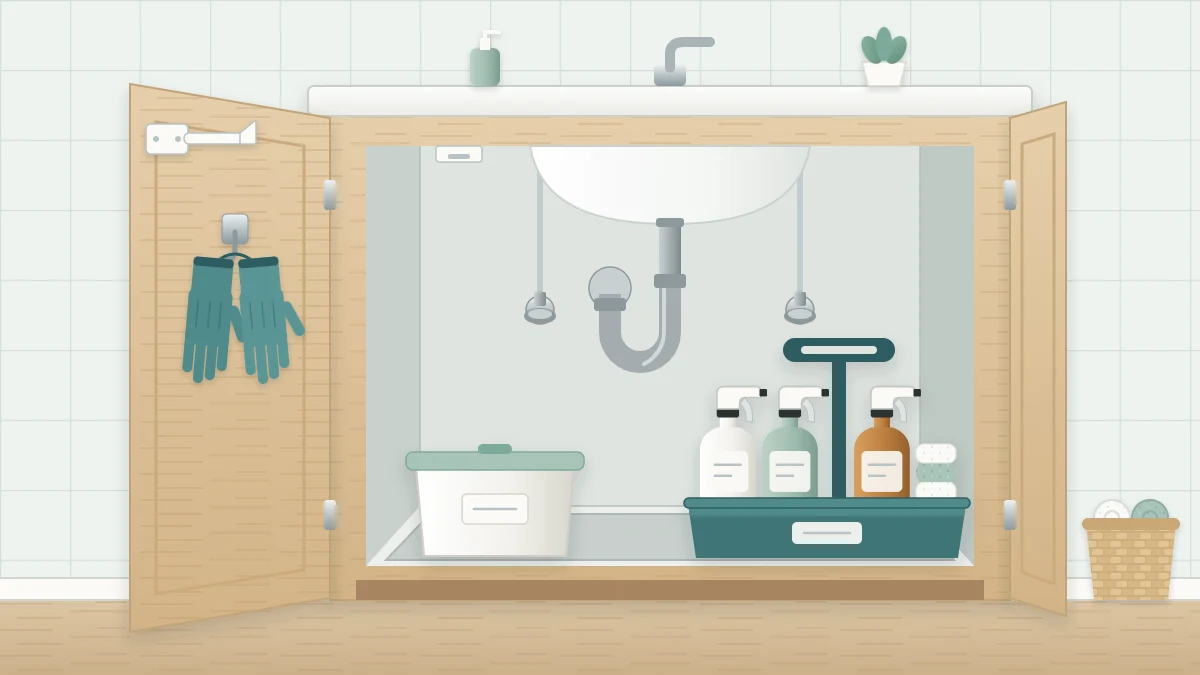
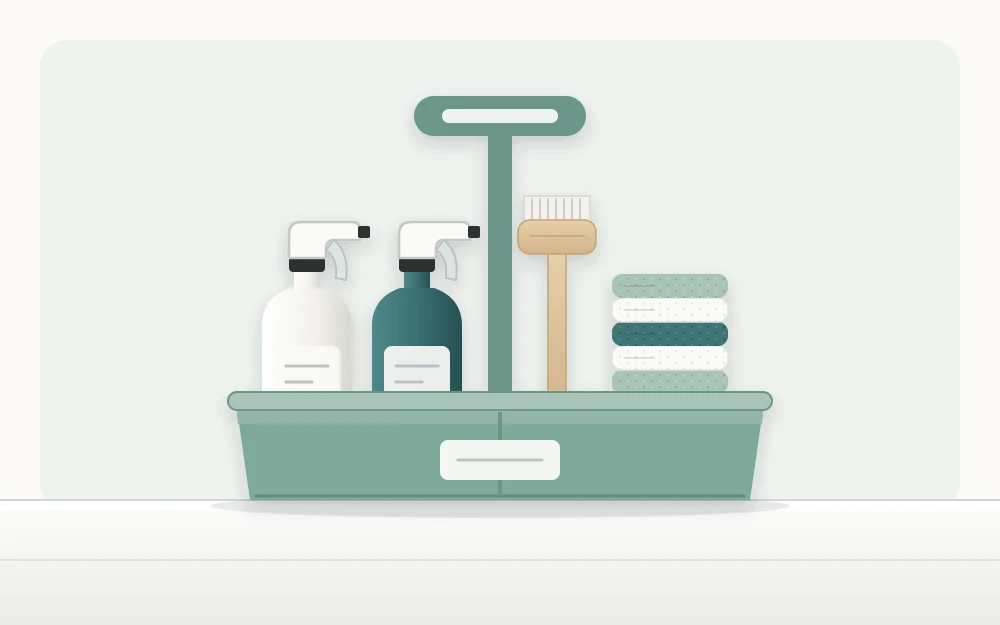
A caddy with a center handle is the simplest answer. The whole kit lifts out in one hand, travels to the tub or toilet, and returns to one footprint in the cabinet. Choose one with sides high enough to keep bottles standing and a wipeable surface.
A turntable or tiered shelf
If you prefer the bottles to stay in the cabinet, the aim is that every label can be read without moving another bottle. A turntable brings the back of the cabinet to the front with a turn. A small tiered shelf raises the back row so labels show over the front row. Either works beside the drain; the guide to under-sink organization explains how to measure and arrange the space around the pipes.
A place for tools
Gloves, cloths and brushes need their own spot so they do not sit on top of the bottles. A small bin beside the caddy or a hook on the inside of the cabinet wall or door does it. Let them dry fully before they go back, and attach hooks to the cabinet itself, following the hook’s instructions, never to a pipe.
A closed bin for spares
Spare sponges, unopened refills in their original labeled packaging and extra cloths go in a separate closed bin. Keeping them apart from the working kit stops the caddy from overflowing. The guide to bathroom baskets and bins covers which materials and shapes suit a cabinet like this one.
Where each piece sits in the cabinet
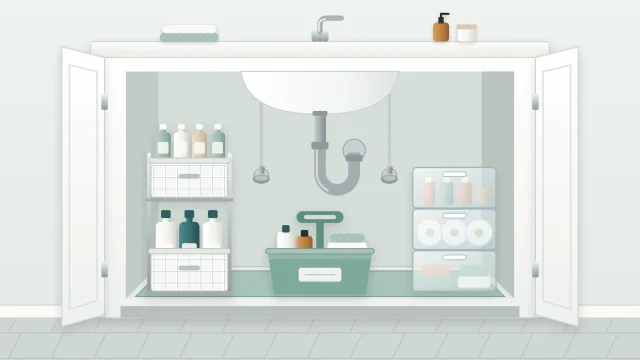
Place the caddy at the front of one side so it lifts straight out. Put the closed bin of spares behind it or on the other side. Keep the kit on a wipeable mat or tray so a drip from a bottle is easy to see and wipe up, and keep the shut-off valves at the back reachable.
It also helps to give cleaning supplies their own side of the cabinet. Toiletry backups and toilet paper go on the other side or on a shelf above, in their own containers, so that nothing from the cleaning kit ends up among things you use on your body.
When the cabinet is not the right place
Some bathrooms have no suitable cabinet: a pedestal sink, an open vanity with no doors, or a cabinet that cannot take a lock in a home that needs one. In that case, do not force it. A high shelf in a hall or utility closet is the better home, with the same rules: original labeled containers, closed, upright, out of reach of children.
The caddy makes this practical, because carrying one container from the closet takes little more effort than opening a cabinet. If towels and bathroom linens share that closet, give the cleaning kit its own shelf, away from them; the guide to linen closet organization shows how to divide the shelves.
A quick check every few months
Lift the caddy out and look at what is in it. Return anything that has drifted in from another room, check that caps are tight and labels are readable, and wipe the mat.
Frequently asked questions
Is it okay to keep cleaning products under the bathroom sink?
Often yes, provided each product's label allows it and the products stay in their original labeled containers, closed and upright. In a home where children live or visit, store them up high or in a cabinet with a child safety lock or latch, which is an extra layer and not a substitute for keeping products out of reach.
How can I make a cabinet of mismatched cleaning bottles look neater?
Not by changing the bottles. Cleaning products stay in their original labeled containers, because the label carries the directions and warnings. For a neater cabinet, reduce the number of products and stand them in one caddy or on a turntable with the labels facing out.
Where should cleaning supplies go if the bathroom has no cabinet?
A high shelf in a hall or utility closet is usually the better home. Keep the products in their original labeled containers inside a handled caddy, so the whole kit can be carried to the bathroom when needed and returned to the shelf, out of reach of children, as soon as the job is done.