Vanity Cabinet Organization: Making Deep Shelves Work
How to stop things disappearing at the back of a vanity cabinet: bins used like drawers, turntables, shelf risers, door storage and a quick table of problems and fixes.
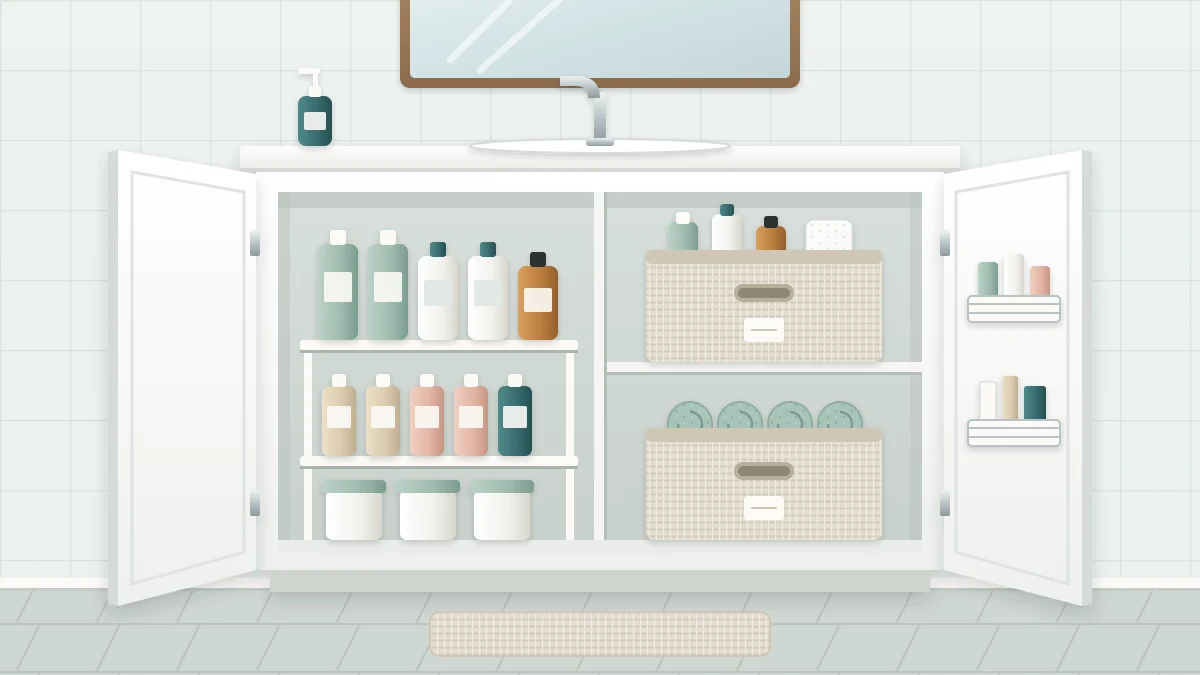
A vanity cabinet is generous with space and stingy with access. It is a deep, dark box, often with one fixed shelf or none, and a door that hides whatever happens inside. Good vanity cabinet organization is mostly about making the back of that box as usable as the front.
If the cabinet is your sink base, pipes run through the middle of it as well. That space has its own guide to under-sink organization; this one covers the general principles for any deep vanity shelf.
Why deep shelves swallow things
On a deep shelf you see the front row and nothing else. Whatever goes in last sits in front, and everything behind it is forgotten until you kneel down and empty the shelf to look. That is how a cabinet ends up with three open bottles of the same thing.
Height is wasted too. A shelf tall enough for a large bottle leaves a wide band of empty air above every short jar, while the floor of the cabinet is completely covered.
The fixes follow from those two problems: bring the back to the front, and divide the height.
Measure before you choose anything
Cabinet openings are narrower than they look, and one obstacle can rule out an organizer. With the cabinet empty, note three measurements:
- Clear width between the hinges or the door frame, not between the cabinet walls. Hinges can take up about 1 in (2.5 cm) or more on each side.
- Depth from the inside of the closed door to the back wall.
- Height under any shelf or pipe, at the lowest point.
Treat these as limits, and choose containers a little smaller so they slide in and out freely.
Bring the back to the front
Anything that lets you move a whole group of items at once turns a deep shelf into something closer to a drawer.
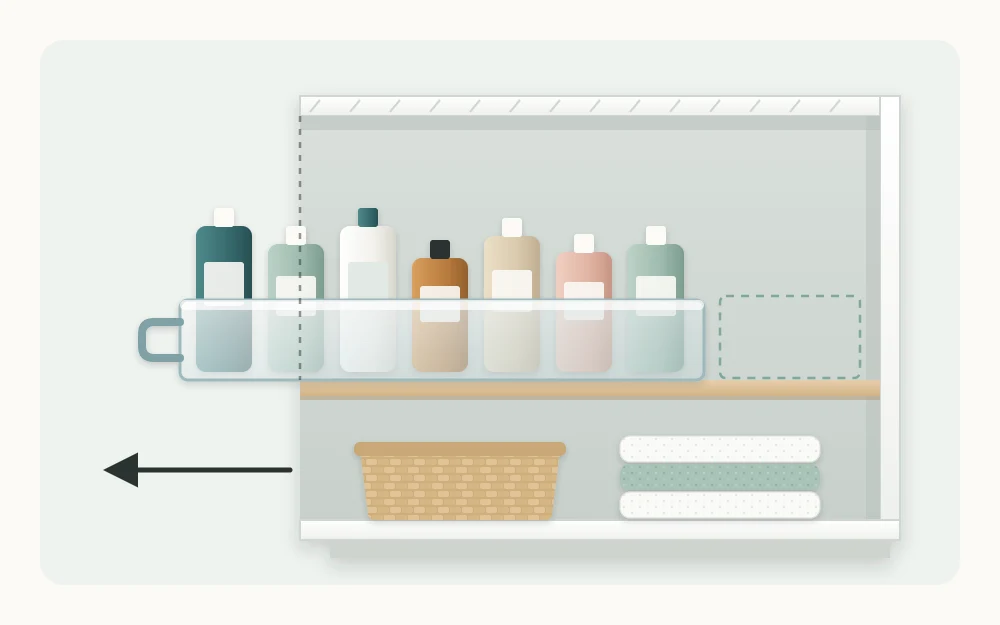
- Bins with handles. A long, narrow bin with a handle on its short end can be pulled out like a drawer. Items stand in it front to back, and one pull brings the last one within reach.
- Pull-out trays and sliding baskets. These run on their own frame and glide out. The guide to under-sink pull-out organizers explains the types and what to check before buying.
- Turntables. A turntable, sometimes called a lazy Susan, brings the back around with a spin. It suits bottles and jars and works well in corners.
For choosing between open bins, lidded bins and baskets, see the guide to bathroom basket and bin storage.
Divide the height
To use the air above short items, add a level.
- A freestanding shelf riser creates a second surface over part of the shelf. Short jars go underneath, another row goes on top, and nothing has to be fixed to the cabinet.
- Stackable drawers do the same with enclosed tiers, and each tier pulls out separately so the lower one stays reachable.
Avoid stacking loose items directly on top of each other. A stack works only until you need the thing at the bottom.
One category per container, front to back
Give each container a single category: hair in one bin, backups of soap and toothpaste in another. Mixed bins turn back into the jumble they replaced, because nobody is sure what belongs in them.
Then arrange the containers by how often you use them. The front edge is for what you reach for about once a week. The back is for backups. Daily items usually belong higher up, in a drawer or on the counter; the guide to bathroom countertop organization covers what deserves a place there.
Tip
Leave a hand’s width of free space at the front of the cabinet floor. It gives you room to slide a bin out without knocking over its neighbor.
The inside of the door
The back of the cabinet door is shallow storage that is easy to overlook. A slim rack or a set of adhesive pockets can take a few flat, lightweight things, such as a comb, a pack of cotton pads or a folded cloth.
Check two things before committing. First, close the door with the rack in place and make sure it clears the shelf edge and whatever stands at the front. Second, read the product’s instructions.
Good to know
Follow the instructions and stated load rating for any door rack, adhesive pocket or hook, including the surface preparation the maker describes. Keep door storage to a few lightweight items so the door still closes and hangs as it should.
Common problems and fixes
| Problem | Fix |
|---|---|
| Things vanish at the back | Handled bins or pull-out trays used like drawers |
| Empty air above short items | Freestanding shelf riser or stackable drawers |
| Bottles tip over when one is taken out | Group them in a bin or on a turntable |
| Nobody knows what is in the cabinet | One category per container, backups together |
| Small flat items get lost | Slim door rack or adhesive pockets |
What does not belong in a vanity cabinet
A cabinet with room to spare tends to attract everything. A few things are better kept out.
- Anything whose label says to store it elsewhere. Products differ, so follow the storage directions on each package, not habit.
- Heat tools that have not cooled. Do not put a hair dryer or styling iron away until it has cooled completely as its manual describes. Store it unplugged, away from the sink.
- Things that belong to another room. A cabinet door hides them, which is exactly why they pile up.
If cleaning supplies live in the cabinet, they stay in their original labeled containers, grouped in a bin of their own. In homes with children, a child safety lock or latch on the door is an extra layer, not a substitute for keeping those products out of reach.
Frequently asked questions
How do I organize a deep vanity cabinet?
Use containers that let you move a whole group at once, such as long bins with handles, pull-out trays or a turntable, so the back of the shelf can come to you. Add a freestanding shelf riser or stackable drawers to use the height, and keep one category in each container.
What should I measure before buying vanity cabinet organizers?
Measure the clear width of the opening between the hinges or door frame, the depth from the inside of the closed door to the back wall, and the height under any shelf or pipe at its lowest point. Choose organizers slightly smaller than these so they slide in and out easily.
Can I use the inside of a vanity cabinet door for storage?
Often, yes, for a few flat and lightweight items in a slim rack or adhesive pockets. Check that the door still closes fully with the rack in place, and follow the product's instructions and stated load rating, including any surface preparation the maker describes.